The senior defence official, however, refrained from describing the kind of responses that the two countries would respond to their common challenges.

More than India's alignment with the Quad, India's defence cooperation and partnership with the USA is of critical importance, notes Rup Narayan Das.
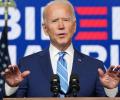
Biden on Friday opened the first Quad Leaders' Summit held virtually and attended by Prime Minister Modi, Australian Prime Minister Scott Morrison and Japanese Prime Minister Yoshihide Suga.
Kurt Campbell, the White House Asia Coordinator, said that in his view India is the most important bilateral relationship for the United States in the 21st century.

President Biden underscored that the United States will 'continue to stand up for its interests and values and, together with our allies and partners, ensure the rules of the road for the 21st century advance an international system that is free, open, and fair', the White House said in a readout of the meeting.
Reconstruction efforts after the Russia-Ukraine war will be dominated by the heft of the membership of major nations across international organisations. India is hamstrung because it does not play host to any major global institution nor does it hold positions of significant influence in the ones in which it has membership. As a result, the world's sixth largest economy is obliged to follow the rules set by most of them.
He said that following a build-up of troops, multiple transgressions and attempts to unilaterally change facts on the ground by China, there have been several levels of talks and a fair amount of communication to ensure that the matter can be resolved through negotiation and diplomacy.
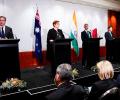
The foreign ministers of the Quad grouping of India, the US, Australia and Japan on Friday held extensive talks in Melbourne amid escalating tension between Russia and NATO countries over Ukraine, the Afghan crisis and increasing concerns over China's "coercion" in the Indo-Pacific region.
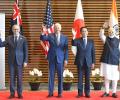
Biden welcomed Prime Minister Modi at the Summit and said "it is wonderful to see you again in person".

The elephant in the room will permeate the conversations, predicts Rup Narayan Das.
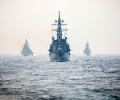
'Any future course of action towards active participation in the alliance when formed would need a lot of deliberation, long term vision and should be in our best national interests,' notes Commodore Vengalil Venugopal (retd).

'This includes increasing restrictions on freedom of expression and the detention of human rights activists and journalists'

Defence and strategic experts on Monday said that China's posturing in the Indian Ocean will disturb stability and peace in the region.

Prime Minister Modi, who is in Japan on a two-day visit to attend a summit of the Quad leaders at the invitation of his Japanese counterpart Fumio Kishida, penned an op-ed on the vibrant relations between India and Japan in the Yomiuri Shimbun.
As India's international role expands, so must our capabilities, says Brigadier Gurmeet Kanwal (retd).
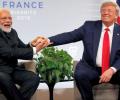
'The US President is joining the Prime Minister in addressing a huge Indian diaspora event in Houston and they will also meet on the margins of the UNGA in New York'
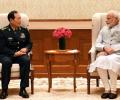
'China's military is expected to deploy full throttle its new equipment including J-20 stealth fighters, drones, medium range missile systems, surveillance and others to continue to put psychological pressure on India,' warns Srikanth Kondapalli, Professor in Chinese Studies, JNU.

A weaker Russia, a sobered China at a time when Xi Jinping is manoeuvring to protect his third term prospects, a reunited West, a chaotic Pakistan. This is a perfect set of strategic circumstances. It is for India now to consummate this historic opportunity, argues Shekhar Gupta.

All that India must aim for is to match China's military prowess adjusted to equal Beijing's India-specific military capability, argues Vivek Gumaste.

Bibhu Prasad Routray explains why the US is supporting Japan's resolve to release 'treated' radioactive waste water into the Pacific Ocean. And what role China plays in the US decision.
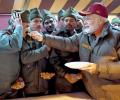
'The BJP has done the Uri surgical strikes, handled the Dokalam crisis and the Balakot strikes.' 'So if there is a de-escalation only at the diplomatic level and not resolving this issue of a colonel being killed, then it translates into public anger.'

Indian policymakers must realise that in buying small quantities of equipment, it becomes hard to start manufacturing them in India, explains Ajai Shukla.
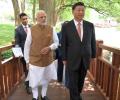
'India's preference today seems to be to exploit the deepening chill in relations with China to breathe new life into its meandering partnership with the US,' argues Ambassador M K Bhadrakumar.

Modi said India will continue its support to ASEAN for a rules-based security architecture for the region.

Foreign Secretary Harsh Vardhan Shringla has met top Biden administration officials, including Secretary of State Antony Blinken and Deputy Secretary Wendy Sherman, and held substantive discussions with them on the strategic bilateral ties and regional and global issues like the current situation in Afghanistan after the Taliban seized Kabul.

Prime Minister Narendra Modi will participate in the first in-person summit of the Quad leaders in Washington on September 24 that is expected to broadly focus on contemporary global challenges including ways to ensure a free, open and inclusive Indo-Pacific.

Price said India's relationship with Russia developed over several decades.

'Notwithstanding the realisation among the Indian leadership to build up its navy for the force's expanding role, the Indian Navy was allocated only 15% of the interim defence budget presented in Parliament in February 2019.' 'The outlay for the navy's capital acquisition is not even adequate to meet its committed liabilities,' points out Brigadier S K Chatterji (retd).

'Both Modi and Xi know that if all that there is to show for Modi's visit -- barely eight months after Xi's India trip -- is a repeat of the same old declarations, there will be a terrible sense of letdown in the public mood resulting in future summits losing credibility. Only the possibility of new ground being broken can justify Modi's trip at this time,' says B S Raghavan.

Indonesia is not even counted as a next-door neighbour of India, though the southern-most tip of India is less than a hundred miles away from the northern-most tip of Indonesia. Bringing Indonesia back in the mainstream of the Indian strategic calculus is a step long overdue, says Dr Rahul Mishra.
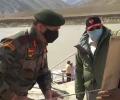
'We should not minimise the seriousness of Chinese encroachments because their perception is different.' 'Nor should we fall into the trap of accepting so-called 'buffer zones' in areas of overlapping claims. We cannot have buffer zones in our own territory,' asserts Ambassador Shyam Saran, a former foreign secretary.
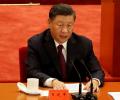
'The world does not care about the tension on our border.' 'India has to emerge as a strong economic power.' 'Respect comes when the world sees a country with a direction and leadership that has a vision,' points out Ramesh Menon.

The prime minister's meetings with Abe and Turnbull came a day after he held "very expansive" talks with US President Donald Trump on intensifying overall security and defence cooperation, particularly in the Indo-Pacific region where China is strengthening its military build up.

Biden has reiterated America's support for India's permanent membership on a reformed UNSC and its entry into the NSG during his first in-person bilateral meeting with Modi at the White House.

The two sides are also expected to explore ways to deepen defence collaboration, including exercises, defence transfers and technologies ahead of the next edition of the 2+2 defence and foreign ministerial dialogue to be held in the US later this year, they said.

'India appears to have stood its ground on strategic autonomy by resisting US pressure on Russia, China and Iran, but succumbed to the temptation to walk into a tighter embrace in defence cooperation, a high priority of the Trump administration,' notes Ambassador T P Sreenivasan.

In the opinion piece after the summit, the leaders said the cooperation, known as "the Quad," was born in crisis. It became a diplomatic dialogue in 2007 and was reborn in 2017.
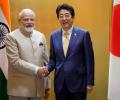
With the signing of the pact, the Quad grouping of India, Japan, Australia and the US is set to gain more heft now, notes Dr Rajaram Panda.
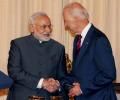
US-India defence cooperation must not adversely affect the India-Russia interface, which has its own strategic meaning and content, asserts Vice Admiral Premvir Das (retd).

Pakistan is once again becoming a frontline State in big-power rivalry. But this time around, Pakistan stands to gain out of its geography, observes Ambassador M K Bhadrakumar.
